
New Year’s Day is widely framed as a moment of renewal, optimism, and forward momentum. Yet across households, workplaces, and leadership environments nationwide, a significant number of people report feeling emotionally heavy, experiencing unexpected introspection, or experiencing internal tension. According to Dr. Andrea Adams-Miller of The RED Carpet Connection, LLC, and The SubConscious Connection, LLC, these reactions reflect patterns of emotional memory triggered by sensory cues, rather than a lack of motivation, gratitude, or resolve.
New Year’s Day functions as one of the strongest emotional memory activation points of the calendar year. Repeated traditions, familiar foods, seasonal smells, archived photos, music, weather, and visual cues unconsciously reactivate emotional experiences associated with prior years. These stored memories influence mood, perception, and decision-making before conscious intention has time to engage.
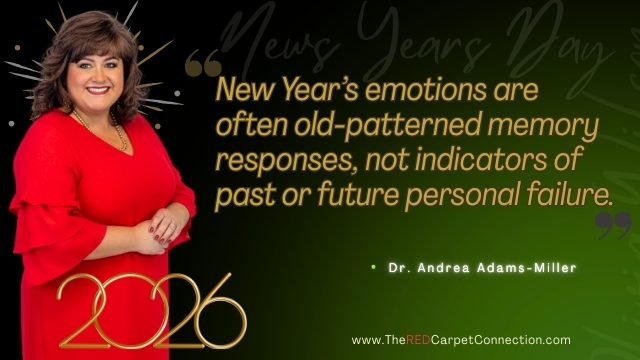
Across households, workplaces, and leadership environments, New Year’s Day consistently activates emotional responses that surprise people precisely because they are misinterpreted as personal or motivational issues rather than memory-driven reactions.
“New Year’s Day compresses memory,” Adams-Miller explains. “When familiar sensory cues repeat, the brain retrieves emotional associations tied to past experiences. People often assume something is wrong with them, even describing themselves as failures, when the nervous system is simply recognizing patterns. Unfortunately, not everyone knows these patterns can be reframed positively.”
Decades of research show that emotional memory is encoded alongside sensory information. Smell, taste, sound, and visual cues are processed through neural pathways that connect directly to the brain's emotional centers. When these cues recur during major calendar transitions, emotional states from previous experiences can surface rapidly and without warning.
Psychiatrist and trauma researcher Bessel van der Kolk, M.D., describes this mechanism clearly: “The brain areas that process sensory information also store emotional memories, so when the senses are triggered, the emotional past can be experienced as if it is happening in the present (The Body Keeps the Score, 2014).”
Peer-reviewed research reinforces this explanation. Findings published in Nature Reviews Neuroscience demonstrate that autobiographical memory retrieval is shaped by emotional salience and context rather than chronological time (McGaugh, 2015). Research in Progress in Brain Research further confirms that sensory cues, particularly smell, possess a uniquely strong capacity to reactivate emotional memory networks (Herz, 2016).
What makes New Year’s Day particularly powerful is its role as a psychological and social checkpoint. Individuals implicitly evaluate continuity, loss, progress, and unresolved experiences from prior years. Emotional responses connected to sadness, anger, fear, hurt, or guilt may surface even in the absence of present-day stressors.
These patterns extend beyond personal reflection. In professional environments, emotionally activated memory states can influence communication tone, judgment, risk assessment, and leadership presence. Executives and teams returning from year-end transitions may unknowingly carry emotional residue from prior outcomes into current decision-making.
“When people understand that emotions can be echoes of memory rather than commentary on their future, clarity returns,” Adams-Miller adds. “That clarity changes how people lead, communicate, and move forward.”
As national conversations increasingly focus on emotional intelligence, resilience, and decision quality, this perspective reframes New Year’s emotional experiences as understandable, explainable, and manageable. Awareness allows individuals and organizations to recalibrate rather than react during the first days of the year.
About Dr. Andrea Adams-Miller
Dr. Andrea Adams-Miller is an applied neuroscience-based communication strategist, executive advisor, and international speaker. Her work focuses on how emotional memory, pattern recognition, and cognitive processing influence behavior, judgment, and leadership outcomes in high-stakes personal and professional environments.
About The RED Carpet Connection LLC
The RED Carpet Connection LLC is a strategic advisory firm specializing in communication intelligence, influence strategy, and cognitive clarity. The firm works with executives, entrepreneurs, organizations, and public figures to align messaging, emotional awareness, and decision-making for sustainable impact and long-term credibility.
Disclaimer: This material is provided for educational and informational purposes only. It does not constitute a medical, psychological, or therapeutic diagnosis or treatment. Individuals experiencing persistent emotional distress should seek guidance from appropriately licensed professionals.
###
For more information about TheREDCarpetConnection.com, LLC, contact the company here:
TheREDCarpetConnection.com, LLC
Dr. Andrea Adams-Miller
419-722-6931
AndreaAdamsMiller@TheREDCarpetConnection.com
8155 Township Road 89, Findlay, OH 45840